

Unboxing: Carol Tack Estate Pt 4
I am attempting to be downsizing/saving for Breyerfest but I couldn't resist bidding on a few really nice vintage pieces from the latest Dosland auction, which was part 4 of the Carol Tack estate. I don't know if it's because we are approaching Breyerfest or there is some Dosland fatigue or it is just a sign of the economy but I thought the prices were surprisingly low on many of the pieces last week. I ended up with five models and they just arrived!
As usual the shipping and packing was excellent (as it should be, they charge a fee for the materials and the packing service). This time around all the models were actually in better condition and cooler than I expected from the photos! Maybe that also kept prices down if others felt the same way about their potential condition.
First up this gorgeous Terrang. He was mislabeled as Count Fleet but I knew this was one of the early Terrang models when they had the really nice shading. I do in fact already have a really nice one but I cannot resist the early Maureen Love racehorses, especially when I can find a mint one with great color.
This one looks basically brand new and he's pretty different from my current one. I had been casually looking for one with this barrel shading and so I'm glad I picked this one up. He will be joining my show string for sure.

Next I picked up this original Flash. I thought he was the chalky version so he actually belongs in my next installment of What I Bought vs What I Got because he turned out to just be a regular one. This one is also basically mint and has nice color and dapples so he will also join my Flash conga.

Luckily I've also been looking for a nice normal example to go with my chalky one so you can really see the different side-by-side.

Weirdly, and since I have been obsessed with this lately because of my shrinky paranoia, this new one is also noticeably smaller than my chalky one. I don't think he's a shrinky, but it is interesting.
The Quarter Horse Yearling in liver chestnut is very rare in the two hind sock variation. They were only made during the very beginning of the run and the vast majority have 4 socks. You can also tell they are early examples because they do not have the USA stamp, which was added sometime in 1970, the year this model was introduced. The catalog photo of the prototype also shows two hind socks, but at some point early on in production they switched it to four. I was shocked when he only ended at $10, but thrilled to get him!
My one total impulse buy was this pinto Western Horse. He had broken reins and a broken saddle but I've been looking for one in this shade for my horseless transitional slip on saddle so I figured I'd throw a low bid on and see if I won. I did! He turned out to be cooler because he also has a Souvenir of Chicago sticker! This wasn't visible in the Dosland photos so that was a cool bonus.

The reins were an easy fix and the new saddle looks good on him. He might not quite be pale enough for the era and I'm not sure if the sticker also throws off the time period authenticity for this particular saddle, so I might keep looking. For now they can be paired together. The broken saddle is the bright red low grommet version, which I believe is the style that was right before they switched to the white transitional one, so I think it is close to being right. The ones I have seen pictures of with this as their original saddle are just slightly paler/more caramel in their chestnut color.
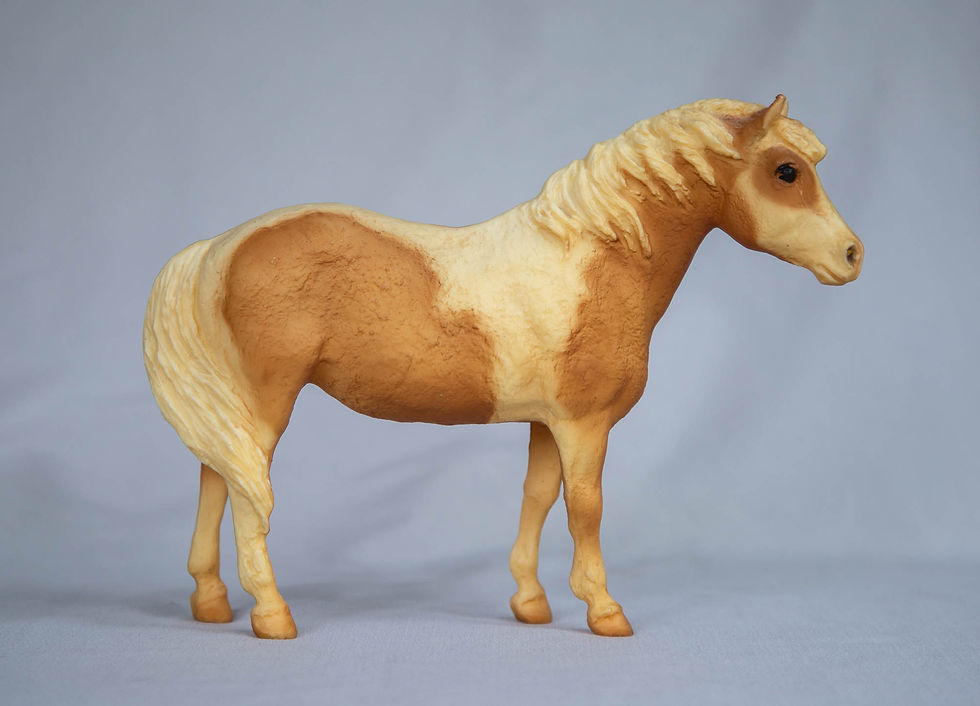
The last and the coolest is this Misty! She looks at first glance like a normal 70s Misty, but if you look closer she is actually an early freehand version. Many of the mid-70s pintos were airbrushed by hand - the chestnut pinto Indian Pony being the most notable, but early chestnut pinto classic Mustang Mares were also free-handed. Misty famously when through a number of pinto pattern iterations as they tried to get it right and as they were developing the mask, some of the first Misty models with this pattern were airbrushed.

You can see on this one where along the edge of the pattern it was first drawn on as an outline and then filled in with color. This is very similar to what you frequently see on early Jasper the Market Hog models that were painted before the mask was developed. You can also see how the edges are not as crisp as the masked ones and the detailed freehand airbrushing up in to her mane. Funny enough I don't currently have a totally normal 70s Misty but you can see the difference in my chalky one who was painted with the mask.
I wasn't the only one to spot her and she ended at $70, but she's totally worth it and a really cool piece to have with my other Misty variations!


Comments