

Bay Breyer Donkeys
I'm a big collector of the standing donkey so I thought it would be fun to do a follow up post on the bay and brown ones. There are soooo many variations of this guy, and they're all pretty inexpensive, so I fell down the rabbit hole many years ago and started collecting all the different ones.
The rarity that eluded me for awhile was the bay version. I first saw one at a live show when I was first getting in to collectibility and I thought it was the coolest thing ever. That one was a very bright bay and the judge gushed about just how rare they are. I immediately started keeping a keen eye out for them on eBay and I did a lot of searches for "plastic donkey" and the like. They are often misidentified because the donkey does not have the Breyer mold mark.
This also unfortunately led me down the "Fool's Bay" path of the Diamond P Hong Kong copy. It's a very good copy and if you're not looking closely you can easily buy one of these thinking it's a bay Breyer donkey. I and pretty much all of my fellow donkey collectors have acquired a Fool's Bay at some point! I didn't end up keeping any of mine so I don't have a photo but this Breyer History Diva shows a good example of one: https://breyerhistorydiva.blogspot.com/2009/09/knock-offs.html

The first brownish one I found was this relatively early example with a small blue ribbon sticker and the added fun of also being a Knott's Berry Farm souvenir with that sticker still on too. The small sticker dates him to sometime around 1966-68. He's just slightly browner than the normal brownish-grey but unless you put him right next to a grey, as shown below, you wouldn't think him out of the ordinary. I probably wouldn't call him the bay variation or even the chestnut version.

The next one I came across is definitely a fully brown variation. I had a fellow collector at a show tell me she thought this one was the chestnut variation rather than the bay and I can see that. It does look more like the so-called Five Gaiter Sorrel color than the bright red bay of that first donkey I saw and which I was still trying to find. His mane and tail are a dark brown rather than black.

It's hard to date many of the donkeys and their variations, but if this is a Five Gaiter Sorrel variation of the donkey then that probably puts him in the early-mid 1960s as well. This color has some other famously rare and oddball releases - such as the Fighting Stallion and Family Arabian set - so it wouldn't be a stretch at all to think they grabbed that paint and did some sorrel donkeys as well.
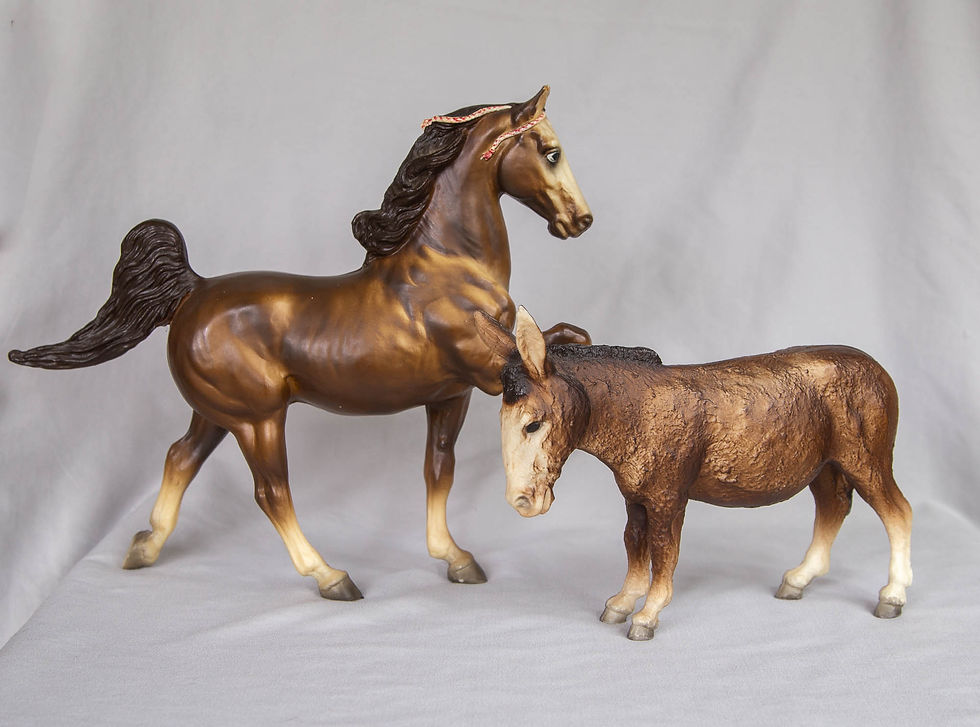
Still I kept looking for that bay! My next find was this now I think truly bay donkey - and as luck would have it, he also has the large blue ribbon sticker - my favorite! He is redder in color than the previous two and the mane and tail look very close to black if not true deep black. The sticker dates him to around 1969-70. Certainly neither this one nor the previous one would be confused for the normal grey color.

And my last one - I can't resist a cool donkey and this one is also a nice bright looking bay. What's interesting about this one is that he does appear to be molded from a regrind plastic - there are some swirls of other colors showing in the white and although he is yellowed the overall color looks more like what we call the "bathwater grey" plastic that was also seen on many of the chalky-era donkeys, unlike my bay sticker donkey above which has a nice bright white normal plastic.

Many of the other bays I have seen over the years have this sort of dull grey looking plastic. A friend of mine also has a bright chalky bay donkey (a grail of mine!) - both facts seem to indicate the bay/brown version was made well in to the chalky era of 1973-74 when they were ultimately discontinued. The below photo from a live show shows a bathwater grey plastic bay variation on the left and the bright chalky bay variation on the right.

The evidence points to these brown and bay donkeys being variations of the regular run 81 donkey and existing for almost the entirety of the nearly 20 year run. At least from the mid 1960s to the mid 1970s. But why? Why these random brown and bay ones on what is supposed to be a grey donkey? Did they just use whatever color they were doing that day on the nearby donkeys? It's a mystery but an interesting one! In a future post I will show some of the interesting grey variations too.


Comments